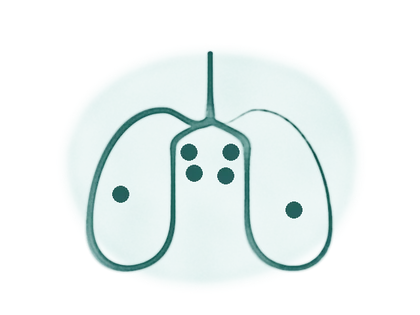
In short: Sarcoidosis is an inflammatory disease in which tiny clusters of inflammatory cells (granulomas) form, mainly in the lungs and in the lymph nodes of the chest. It most often appears between the ages of 20 and 50. In many people it resolves on its own, and only some patients need treatment.
Symptoms
Cough, shortness of breath, fatigue and joint pain. Sometimes there is also a rash or lumps in the skin, and eye symptoms. Quite often the disease is discovered incidentally, on an X-ray or CT done for another reason.
How it is diagnosed
Chest CT, pulmonary function tests including diffusing capacity, and blood tests. When needed, the diagnosis is confirmed by a biopsy taken during bronchoscopy, from the lymph nodes or the lung. It is also important to rule out other causes. In addition, we check whether other organs are involved: the eyes, heart, skin and kidneys, as well as blood calcium levels.
When to treat
Not every patient needs treatment. When organ function is not affected, follow-up alone is usually sufficient. Treatment is needed when there are significant symptoms, declining lung function, or involvement of important organs such as the heart or the eyes. The basic treatment is corticosteroids, sometimes combined with steroid-sparing drugs such as methotrexate (Metoject as an injection). In refractory disease, a biologic therapy, such as the anti-TNF agent infliximab (Remicade), may be considered.
Care team
Sarcoidosis can involve several organs, so when needed we work together with ophthalmologists, cardiologists, rheumatologists and dermatologists.
Frequently asked questions
Is sarcoidosis a type of cancer?
No. It is an inflammatory disease, not a malignant one, and it is not contagious.
Does the disease go away?
In many patients it settles on its own within two to three years. In others it persists and requires follow-up and treatment.
Related topics
General information only; it does not replace a medical consultation. עברית